Kwantung Army
The Wind-Up Bird ChronicleThe Kwantung Army, Japan’s force in Manchukuo, is portrayed as a powerful occupying institution whose claims to command and preparedness repeatedly collide with shortages, political hesitation, and institutional collapse. Its story runs from ambiguous border policy and military intelligence work to the breakdown of its defenses in August 1945; across these episodes, logistics and bureaucracy shape what the army can do, while its orders expose the human costs of its rule.
Organization and strategic setting
In the late 1930s, the Kwantung Army was already stretched by Japan’s war in China. Its leaders recognized that occupying such a vast country could not be sustained simply by winning local battles, even as officers in Hsin-ching could carry on a comparatively comfortable routine. The narrator of the Manchurian military account calls that calm a make-believe peace: the wider war was growing more costly, relations with the United States were worsening, and the prospect of a conflict with the Soviet Union remained consequential.
One pressure point was the western border of Manchukuo, especially the poorly mapped Hulunbuir Steppe and Khalkha River region. The army’s surveys had not produced sufficiently precise maps, while declaring an official border unilaterally risked an international incident with the Soviet Union or Outer Mongolia. Since the Kwantung Army’s resources were committed to the war in China and the newer Manchukuo regime’s stability was its immediate priority, the army accepted an indefinite, wait-and-see approach. It sought to postpone a border decision even as that vagueness left the region inadequately charted.
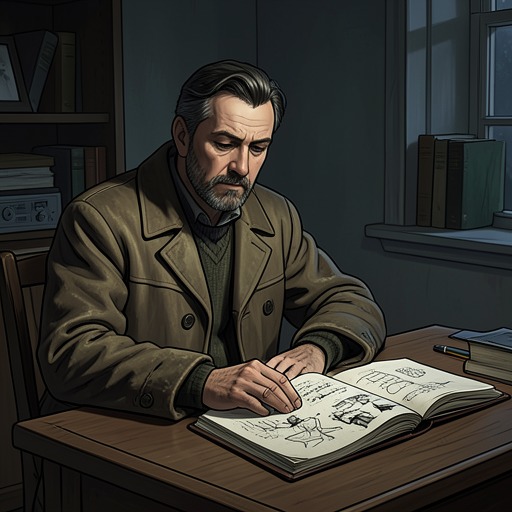
The uncertainty did not remove the military need for accurate information. If fighting broke out, commanders would require more than general maps: combat maps needed to indicate camp sites, artillery positions, marching times, and access to water and horse feed. The narrator’s surveying assignment therefore overlapped with intelligence work, linking topography to preparation for a possible war. The irony is structural: political caution delayed the maps, but the prospect of war made detailed maps essential.
Preparation, supplies, and the limits of planning
The army’s preparations for extreme cold reveal how material limits could shape strategy before a battle began. A research team established within the General Staff Office investigated winter equipment for a hypothetical war with the Soviet Union. Tests on Sakhalin compared Japanese gear with equipment used by the Soviet Army and Napoleon’s forces; the team concluded that Japanese troops could not endure a Siberian winter with the equipment then available. It estimated that frostbite could disable roughly two-thirds of front-line infantry and calculated the sheep and processing capacity required to outfit ten divisions with effective winter clothing. The scale of the proposed procurement underscores how far preparation depended on supplies, transport, and industrial capacity, not simply on orders or troop numbers.
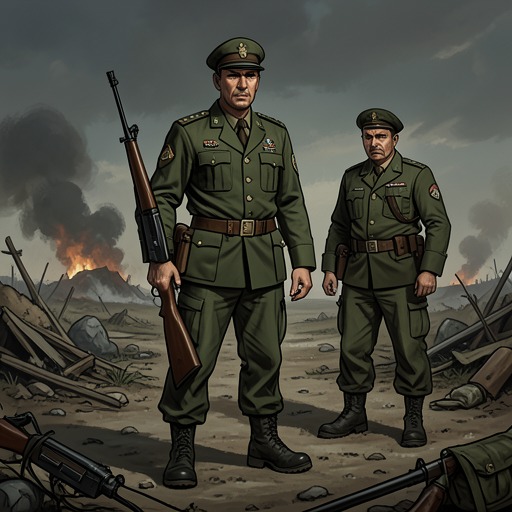
By the Soviet invasion, those weaknesses had become more acute. The Kwantung Army had sent its crack troops and much of its equipment south to support the expanding war. Tanks and anti-tank guns were gone; most transport trucks were unusable, and spare parts were unavailable. Mobilization could assemble men, but there were not enough rifles or ammunition to equip them all. The force once styled the Bulwark of the North had become, in the narrative’s phrase, a paper tiger facing Soviet mechanized units arriving from Europe with equipment and confidence.
Ammunition scarcity also governed the army’s response to the crisis at the zoo. A young lieutenant received orders to kill dangerous animals, preferably with poison to conserve bullets. The promised poison had not arrived; the zoo’s remaining supply was inadequate, and the headquarters officers who might have clarified the order were missing or occupied with evacuation, document destruction, and defensive preparations. The lieutenant ultimately chose to use bullets, reasoning that failure to carry out the task might bring punishment if the army continued to function. The episode makes command appear at once rigid and hollow: orders remained binding even when their means and responsible authorities had disappeared.
Collapse and abandonment in 1945
As Soviet forces advanced toward Hsin-ching, the Kwantung Army’s leadership withdrew its main force toward the rear, leaving small border garrisons and Japanese civilian settlers exposed. Farmers without arms were killed as the Soviet advance moved too quickly for prisoners to be taken; the border garrisons, isolated in their fortifications, were overwhelmed without support. Senior Japanese officers arranged transfers to new headquarters near the Korean border, while the puppet emperor and his family fled the capital by private train.
The Manchukuo Army’s Chinese soldiers deserted or rebelled rather than die defending Japanese rule. Chinese officials argued that Hsin-ching should be declared an open city and surrendered without armed resistance, in order to prevent further chaos and bloodshed; the Kwantung Army rejected that proposal. The capital was left in a political vacuum as the authorities who had built and governed it fled, withdrew, or refused to surrender it. The contrast between the army’s continuing claim to authority and its shrinking capacity to protect the city’s residents defines its final days.
The soldiers sent to the zoo expected to die fighting the Soviet Army within days. They carried out the order to kill the animals before that anticipated defeat, although the narrative notes that the men were instead disarmed and sent to labor in Siberian coal mines, where three would die. After the killings, Chinese workers agreed to remove the carcasses in exchange for the hides and meat, particularly bear meat, which could be sold or used medicinally. The veterinarian accepted because the city had no practical means to dispose of the bodies and the workers had offered the only workable arrangement. The zoo episode thus joins military command, dwindling ammunition, urban breakdown, and the local population’s efforts to manage the consequences of the army’s orders.
War economy and institutional consequences
The Kwantung Army’s history is connected to the wider military system that moved people, information, and resources across Manchuria. Earlier, the narrator’s border assignment placed him between topographical work and intelligence channels, including the army’s intelligence section and the military secret service in Hailar. Later, the account of Soviet captivity describes a strategic coal mine administered under a different regime, where production targets were prioritized over prisoners’ survival. The mine is not a Kwantung Army unit, but the contrast extends the book’s scrutiny of military and state systems: institutions measure success through strategic objectives and production even when human beings are treated as expendable.
The account also records Japanese responsibility within Manchuria, not only the damage inflicted by the Soviet advance. The narrator says he had learned of Chinese laborers deliberately killed during construction of a secret base at Hailar so that they could not disclose its plans. He connects that knowledge with what he witnessed under Soviet rule and concludes that neither communist ideology nor Japanese conduct in Manchuria could be separated from the systems that enacted them. The Kwantung Army therefore stands in the narrative not merely for a defeated force, but for an occupying institution whose strategic projects and failures implicate those who carried them out and the people made to bear their costs.
Taken together, the border maps, winter-clothing calculations, missing supplies, abandoned defenses, and zoo orders show an organization repeatedly forced to confront the difference between ambition and capacity. Its final collapse does not erase its earlier power or its responsibility for occupation; rather, the retreat exposes how fragile its authority had become, while the civilian and animal casualties left behind make that failure concrete.